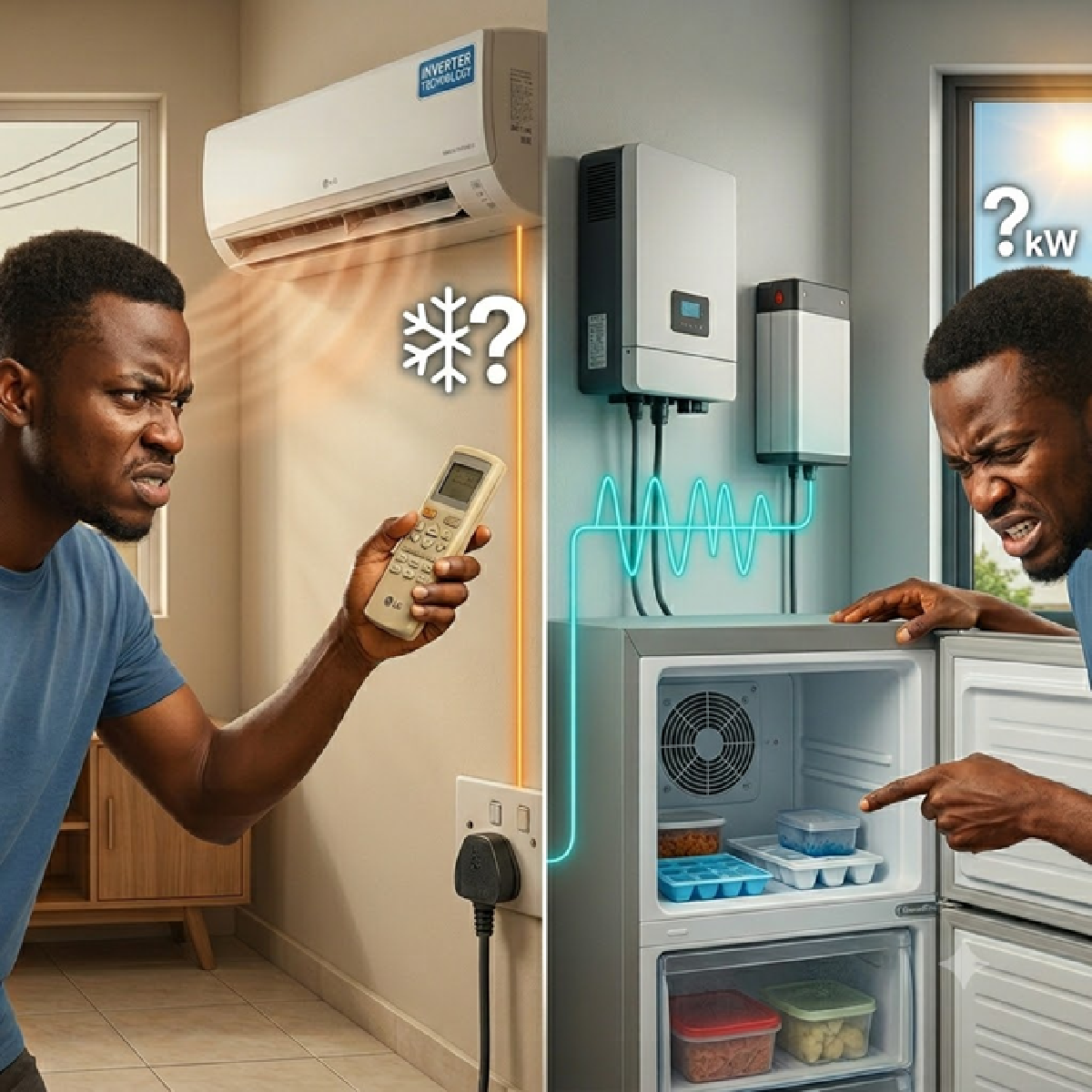
Solar vs Grid Electricity: Why Your Fridge, Freezer or AC May Not Cool Properly on Solar
There is a subtle yet persistent misconception that electricity from the grid (NEPA or PHCN) is "stronger" than the electricity current from solar energy, i.e., solar and inverters. Proponents of this claim that cooling systems like refrigerators, freezers, and air conditioners running on a grid supply chill or cool better than when they are running on solar.
This conception is wrong, and in many cases, the quality of electricity from solar energy and inverters is cleaner and more stable than electricity supplied by the grid. In this article, we will put an end to this misconception that has existed for many years by giving you more clarity on how these things work.
If you also think you are having this issue, we have also detailed a troubleshooting guide for you.
First Of All, Electricity Is Electricity
Electricity doesn’t care if it was generated by a gas turbine at a power plant, a solar panel on your roof, or from biogas. It consists of the same electrons moving down a wire to your appliances, and those appliances of yours do not care how it is generated, as long as it satisfies its power rating, it will work perfectly.
Now, when we talk about giving the appliances the required power specification for them to function properly, we compare both systems. That is the grid or PHCN and solar energy.
While the grid aims to deliver a stable 220-230V at a frequency of 50Hz, they do not steadily achieve that in reality, else stabilizers and voltage regulators will be out of business. Grid supply can have fluctuating currents and voltage spikes, which might harm your appliances or prevent them from functioning as efficiently as they were designed.
In solar energy systems, the solar panels capture light and sends them to the inverter as direct current (DC). The inverter then converts the DC current to alternating current (AC), the same as that supplied by your grid. But the inverter tightly regulates the voltage at exactly 220-230V and sets the frequency at exactly 50Hz, which is best for sensitive equipment. You can even set your preferred frequency in some modern inverters.
Why Does the Myth Exist?
If electricity from solar energy and inverters is so clean, then how did the false information originate in the first place, and why do some people still swear that their fridge or AC performs better on grid power or NEPA?
Hold on, because it is our duty as solar experts to explain their experiences.
1. Voltage Drops Due To Undersized Cables
This is the number one culprit, especially for current users with quality inverters. Electric currents travel over distances in wires to reach the appliances that will use them. As they travel, voltage drops occur.
When smaller-than-recommended wire sizes are used, the voltage loss can become so much that, although the appliance starts, it will not run efficiently.
Hence, the compressor in your fridge, freezer, or AC will pick up, but because of the lower-than-required voltage, it will not be able to compress the refrigerant gas efficiently, hence, it will not cool or chill as it should.
This occurs in sub-standard installations when low-quality wires are used to save cost. The solution to this is to recable the installation with the proper size of quality wire.
2. Low Quality Inverters (Modified Sine Wave Inverters)
This is the second major culprit behind the origin of this misconception, and if you check further, the timing of the misconception is as old as the period when modified sine wave inverters were popularly sold and used.
This type of inverter produces electricity that is not as smooth as normal utility power. They will work well with appliances like fans and lights, but other sensitive equipment like TVs and radios might show flickering screens and humming sounds, while others, like cooling systems, might not run efficiently.
The solution to this is to change the inverter to a modern one that produces a pure sine wave.
Other Causes
The two factors above are the main reasons why your solar system and inverter, in other sense, will seem to be working well, but some appliances will be underperforming, compared to how it works while running on the grid.
The following issues shows itself more boldly and might cut off the energy supply.
1. Undersized Inverters
When an inverter is forced to carry more than its capacity, it will trip. When high-energy-demanding appliances kick on, they draw a surge current that might temporarily trip off the inverter if it is unable to carry the total load at that time.
The inverter in this case might trip off, or the appliance, like an AC, fridge, or freezer compressor, will not start, leaving the user thinking that the fault is from the solar and that the solar energy current is not strong enough to make the appliances give that chill cooling.
2. Low Battery Voltage
As started earlier, the loads from most of these cooling appliances are referred to as inductive loads because of the surge current they draw on startup or when the compressor kicks in. This surge current, which can be 2 to 3 times or more of the running current, exerts pressure on the battery, especially tubular batteries, and causes a drop in the battery voltage, which is called a voltage sag.
If the battery is low or the battery's cells themselves are weak, it might not be able to withstand that quick burst of energy demand. This makes the inverter either trip off, or the appliance just stays on without the compressor picking up or running fully.
Summary
If your appliances, especially sensitive or cooling appliances like a refrigerator, freezer, or AC, cool poorly or underperform on solar but work well on a grid supply, the cause is not where the electricity comes from, but how well the solar system has been designed and installed.
That's why choosing experienced solar professionals and high-quality equipment is just as important as deciding to go solar. With a professionally designed solar installation, your appliances will chill just as deeply, run more quietly, and last years longer without the threat of a sudden grid surge burning them out.
Related Articles
DIY Guide: How Cleaning Dirty Solar Panels Ensures Full Power, Lifespan & Safety
Solar panels are designed to last for many years under harsh weather conditions while generating clean energy. However, one maintenance task that many...
.png?alt=media&token=1c41250f-028b-4faa-84d3-6a3f77b1d837)
How to Fix Lithium Battery Communication Error Between BMS & Inverter (Fault 61, F58, Error 67, Warning 20)
When a solar system is working properly, the lithium battery's battery management system (BMS) and inverter work together like a coordinated team,...
Why Your Lithium Battery Drains Fast & Won't Last Its Long Lifespan
You bought that costly lithium battery with 6000 cycles and a 5 to 10 years warranty, with the dealer's assurance that it will last up to 16 years...