
Debate Between Tubular Battery (Wet Cell) Vs Lithium Battery: Which Is Better & Lasts Longer?

Choosing between a tubular (wet cell) non-free maintenance battery and a lithium battery depends on several factors. Both types of batteries are strong and effective in storing energy for inverter and solar applications. The difference, which stems from how both types of batteries are made, shows up in their respective performance. In this article, we will be looking at the differences between a tubular battery and a lithium battery, by comparing their advantages and disadvantages in real world usuage with the purpose of finding which of them lasts longer and is overall the best.
1. Chemical Makeup
Tubular solar batteries use lead-acid chemistry. Energy is generated by a reaction between the lead plates and the electrolyte solution of sulfuric acid and distilled water, in which it is submerged in. That is why the battery's performance goes down if the liquid solution is low, and it can get damaged if it goes dry.
On the other hand, Lithium Batteries (Lithium Iron Phosphate - LiFePO4) are essentially made up of a Lithium Iron Phosphate cathode (positive electrode), a carbon/graphite anode (negative electrode), and a solid or gel-like electrolyte. It is a solid-state sealed battery.
2. Maintenance
A major advantage lithium batteries have over tubular or wet cell batteries is that lithium batteries are maintenance-free, while tubular batteries require the recommended demineralized water to be above the recommended level, as seen on the gauge.
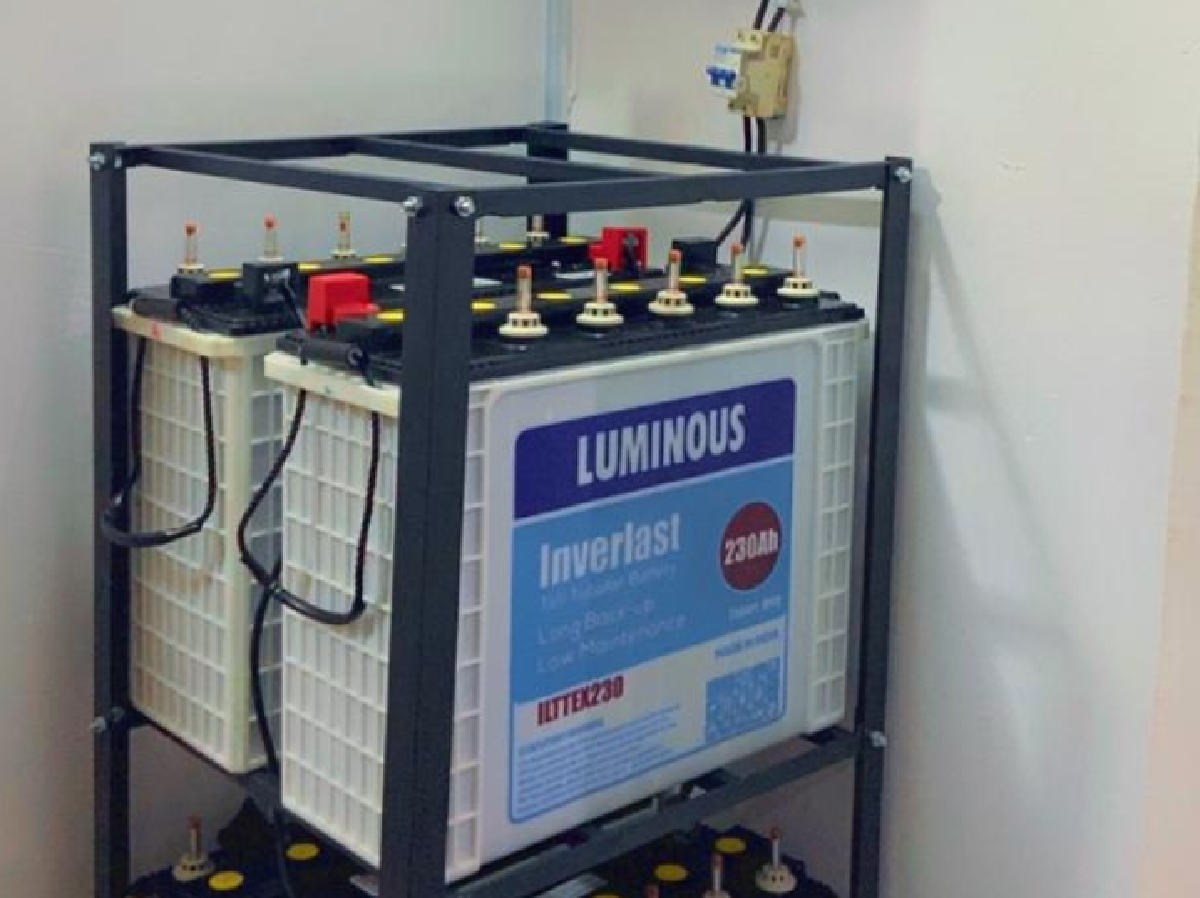
Tubular batteries or flooded batteries are not maintenance-free. They have gauge markers at the top of the batteries, which indicate the level of the electrolyte. Distilled water must be added to the batteries so it doesn't go below the red mark. If it is not properly maintained, it can go bad.
But do not worry, this is not something you have to check or do every now and then. Depending on the battery’s usage, it can go for several months before it requires a topping of distilled water.
Also, distilled water is very cheap, and it ensures the battery’s usage and performance. Meanwhile, lithium batteries do not require topping up of "water" periodically. It's essentially a set-and-forget system.
3. Size & Space
Lithium batteries are known for their high energy density. It can store a large amount of energy in a relatively small package, hence taking up very little space. With the drive towards renewable energy, lithium batteries have a wide range of applications, especially in electric vehicles.
Tubular batteries come in smaller 12V capacities, and many units of them are contained in a single lithium battery. Tubular batteries can easily crowd a room's space when a large battery capacity is needed.
In real-life applications, a single 15kWh lithium battery is equal to about 6 to 12 tubular batteries. The latter figure of 12 is gotten at a DOD of 50%.
4. Depth of Discharge (DOD)
Depth of discharge is the percentage of the total capacity of the battery that you can safely use. Lithium batteries offer a higher DOD at 90%, although manufacturers usually rate their number of cycles at 80% DOD.
Meanwhile, most tubular batteries, although stating a deep-cycle use, have a recommended 50% DOD for maximum lifespan. However, some high-grade tubular batteries like Luminous Inverlast, Exide InvaTubular, offer a 80% DOD. However, in general, using your battery at a lower DOD usually translates to a higher cycle count.
5. Number of Cycles
A battery completes one cycle when its full capacity is used up and recharged. This must not be completed at a go. When the battery discharges and charges up at various levels, they add up to complete a cycle.
Lithium batteries are the clear winner here. They usually offer 5,000 to as high as 8,000 cycles, depending on the brand, with 6,000 cycles at 80% DOD being the most common. Tubular batteries, depending on the quality of the brand, usually offer from 1000 to 1,500 cycles, with high-grade brands having 1,800 cycles at 80% DOD.
6. Lifespan
As a result of the higher number of cycles and DOD lithium batteries have, they have a longer lifespan of about 10 to 15 years; however, you should watch out for these things that might cause yours to fail prematurely.
Tubular batteries last for about 3 to 5 years, with the high-grade brands lasting 6 to 7 years. The lifespan of tubular batteries is also affected by its cummulative quality of maintenance (topping of distilled water).
7. Charging and Discharging rate
Lithium batteries charge faster and can be discharged faster than tubular batteries. Tubular batteries are recommended to a maximum continuous discharge rate of 10% to 20% of their total Ah capacity per hour.
That means that the maximum current you can continuously draw from a single 12v 220ah tubular battery is 264W to 528W. They can also handle surge demands, but drawing very high currents from a tubular battery causes a voltage sag, where the battery voltage drops so low that the inverter thinks that the battery is low, when it still has high usable energy in it. This usually happens when inductive loads like microwaves, pumps, and ACs are run on tubular batteries.
The recommended maximum charging current of tubular batteries is 10%–12% of their capacity, which translates to 22A to 33A. Charging tubular batteries at faster rates causes excessive chemical reaction that can permanently reduce the battery's capacity. It also creates excessive gassing and water loss.
Lithium batteries have a maximum charging current of 0.2C to 1C of their total capacity. This means that the battery can be speedily charged to full in one hour if the need arises, and this is most suitable in places with poor and unstable power supply from the grid.
Unlike tubular batteries, lithium batteries support fast discharging and can support 0.5C to 1C, which translates to discharging 50% to 100% of the battery's capacity between one and two hours.
However, charging and discharging lithium batteries at high speeds shortens their cycle count and overall lifespan. Most brands of 15kWh 48V lithium batteries recommend a maximum charging and discharge current of 100A.
8. Performance & Failure
As discussed above, lithium batteries perform better than lithium-ion batteries in most aspects. A lithium battery is a single high-energy pack that rarely fails prematurely when all the safeguards are put in place. Tubular batteries, although they are highly resilent, must work together in groups (series and parallel connections), to give the same amount of energy backup as a singular lithium battery contains.
When these singular units, tubular batteries, are connected together, the weakest battery in the chain affects the entire system. If one battery starts failing and becomes weak in a battery bank of tubular batteries, the entire bank will start shutting down prematurely. And depending on the age of the system, it might be unwise to replace only that failing unit, forcing the entire battery bank to be overhauled.
This is one of the major disadvantages of using tubular batteries in a large battery bank like the 96V, 180V, or 360V system. This is the reason why using quality tubular batteries is essential to mitigate manufacturers' defects and premature failures.
9. Resilience
Tubular batteries are more resilent and tolerate abuse better than lithium batteries. While heat is the silent killer of lithium batteries, tubular batteries handle it much better. They also handle charging issues and voltage spikes better.
Thanks to their flooded makeup, which allows lightly sulphurated batteries to be revived, tubular batteries fare better than lithium batteries in situations where they are totally drained and left uncharged for days. However, if tubular batteries are always undercharged, they can become sulphurated, unlike lithium batteries.
10. Cost
Lithium batteries are more expensive than tubular batteries. Although the higher DOD and lifespan will pay off the investment, the upfront price might be too high for many users. Tubular batteries, on the other hand, are more affordable and offer even smaller sizes like the 150ah, which are further lower priced.
11. Flexibility With Inverter Pairing
Another drawback of lithium batteries is that their installation and pairing to an inverter/solar charge controller must strictly follow the manufacturer's instructions and compatibility. You just cannot connect a lithium battery to any inverter, charger, or solar charge controller in the market. They must be compatible and support lithium function with a quality battery management system (BMS). The absence of a battery management system (BMS) can pose a serious fire risk.
Meanwhile, tubular batteries can be used with any type of charger, inverter, or solar charge controller. However, a charger with a dedicated tubular battery function will offer a battery equalization function, which prolongs battery life.
12. Safety & Risk
While lithium batteries are very safe to use when properly installed within the manufacturer's settings and protections like breakers, the makeup and resiliency of tubular batteries make them less susceptible to the risk of fire breakout and explosions that can occur in faulty lithium battery installations.
While tubular batteries emit very minute amounts of gas (oxygen, hydrogen, and acidic vapour) during the charging process, they still must be installed in ventilated areas.
13. Aesthetics & Design
Whether wall-mounted or standing, lithium batteries look more appealing to the eyes and give a luxurious built-in vibe. They also offer more built-in tech for comfort and ease of use to access battery information.
On the other hand, tubular batteries give a somewhat "garage vibe", especially when they are installed in numbers. Also, they might not appeal so much to the eyes as they age due to rust that might appear on the battery racks, discoloration on the floor from spillage, and sulfuration that might appear on battery terminals.
Tubular batteries are also less "user-friendly", and you must use external appliances like an inverter or battery readers to check their information.
Summary
Here you have it, the ultimate review and debate on the differences, disadvantages, and advantages of lithium and tubular batteries towards finding out which is better. Lithium battery clearly has more advantages than tubular batteries and will generally last longer both in daily use and overall lifespan.
However, real-life choice will depend on the user's application, space, budget, and other factors listed above. So if you are calendar-cautious and prefer the old, rugged, and less techy battery solution, and also have that extra space and do not care about some little rust and spills, then tubular batteries can win you over. But if you are space-conscious and want a fancy-looking and energy-packed single power bank, say hello lithium!
Related Articles
Top 5 Best 220ah Tubular Inverter Batteries To Buy For Your Solar Installation
Despite the lingering debate on which is better between tubular batteries and lithium batteries, the truth remains that high-quality tubular batteries...

Felicity vs Luminous vs Deye: The Ultimate Comparison For Nigerian Solar Buyers
If you have been following Nigeria's solar industry, you would know that it has changed drastically over the last few years. The solar energy mark...
.png?alt=media&token=1c41250f-028b-4faa-84d3-6a3f77b1d837)
How to Fix Lithium Battery Communication Error Between BMS & Inverter (Fault 61, F58, Error 67, Warning 20)
When a solar system is working properly, the lithium battery's battery management system (BMS) and inverter work together like a coordinated team,...