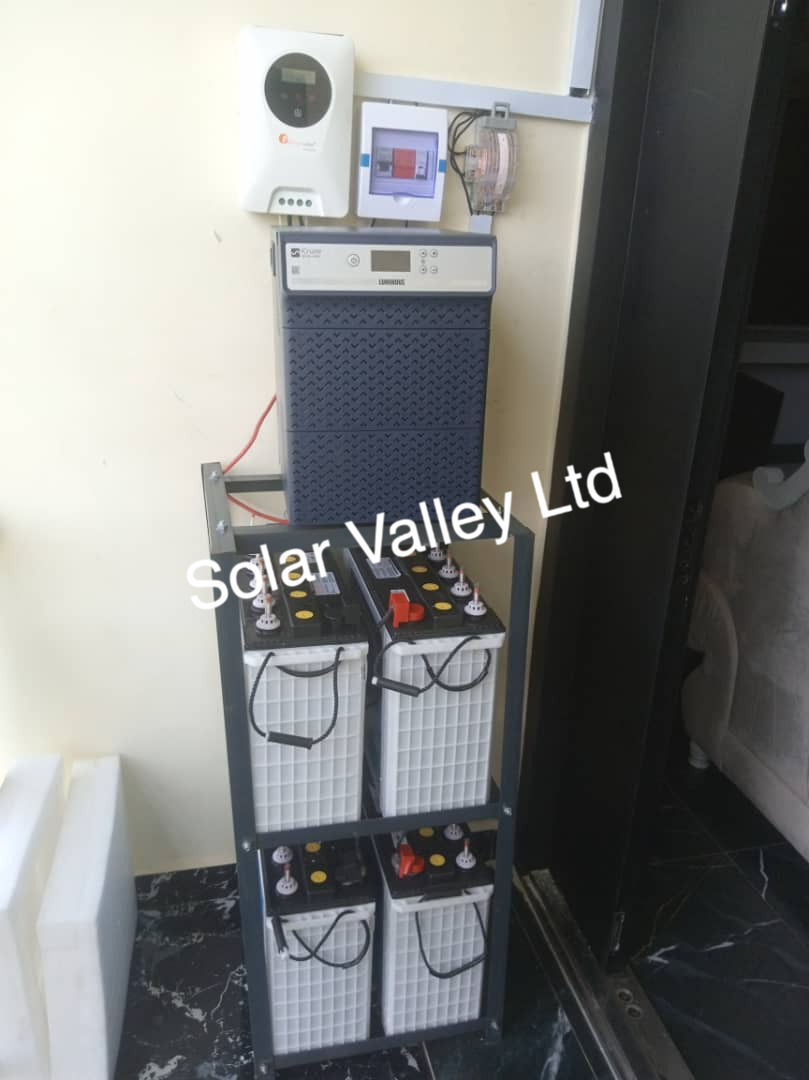
About The 3.5kva, 4kva & 6.2kva Solar System: Number Of Batteries, What It Can Carry & How Long It Will Last, Etc.

The 3.5kva and 4kva 48volts inverter and solar energy system was the popular demand for many looking for more power to carry their home and office appliances such as fridges, freezers, air conditioners (AC), photocopiers, pumping machines, etc, in addition to televisions, fans, computers & lighting points, etc, for a longer time.
Now, it has been mainly replaced by the 5kva and 6.2kva 48v inverter and solar system that mostly comes either as a standalone inverter or high-frequency transformerless unit.
Though the 3.5kva and 4kva systems can carry more load than their 1.5 to 2.5kva predecessors, the maximum watts drawn from them at any given time should be subject to the recommended maximum output capacity of the inverter.
Although KVA simply means 1,000-volt amps, depending on the power factor (PF), the 3.5kVA/4kVA inverter might not produce 3,500watts or 4,000w respectively. While modern transformerless inverters can boast of a PF of 1, the ideal for calculations, especially for transformer-based inverters, is 0.8. The rated maximum output of an inverter differs according to its brand, and you should check the manufacturer's label for the continuous load output rating.

The 3.5kVA and 4kVA 48V solar energy system gets its title from the capacity of the inverter. It simply means the inverter can carry loads up to its recommended maximum capacity, and it can draw the same amount of power from the batteries. The solar panels can have way more than the inverter's size.
A 48-volt system, in contrast to the 24v system, comes standard with 4 units of 12v 220ah tubular batteries, or 12-volt 200ah dry cell batteries, or 48v lithium battery.
How long a 3.5kVA and 4kVA inverter/solar energy system will last depends on the load it carries, as well as the state of charge and quality of the battery.
On a constant load of a 150-watt TV, 3 ceiling fans, one fridge/freezer, 10 bulbs, and 80% DOD;
- 4 tubular batteries will last for about 12 hours.
- 10kwh lithium will last for about 12 hours or 14 hours at 90% DOD.
- 15kwh lithium will last for about 18 hours or 21 hours at 90% DOD.
Tubular batteries last for about 3 to 6 years, with top-quality brands being at the higher spectrum. Lithium batteries can last up to 10 to 15 years.
Transformer inverters can last from 10 to 15 years, while well-maintained transformerless inverters can reach 10 years lifespan.
This system size can be installed with 8 to 12 320W to 350W solar panels or 6 to 10 550W solar panels. There is no fixed number of solar panels, and it depends on the user's load up to the maximum PV rating of the solar charge controller or hybrid inverter.
Due to the larger battery size and load, it is highly recommended that an MPPT solar charge controller be used for the installation. Though a PWM solar charge controller “will work”, it is very less efficient in converting solar energy received by the solar panels, and the loss in solar power will inadvertently negate its cheap cost.
Related Articles
Ultimate Guide to Inverter Sizing: Load Calculation, Watts to kVA, Surge Rating & Appliance Power Usage
Just like knowing the size of your trousers before making the final purchase at a clothing store, estimating your total load and getting the correct s...
About The 6.2kva (6kva) Hybrid Inverter: Cost, What It Can Carry, How Long It Will Last
With the introduction of the solar hybrid transformerless inverters, the 6.2kva or 6kva hybrid inverter, which usually comes in variants of 5kva, 5.5k...
Causes Of Solar Panel Fires, Battery Explosions & Burning Inverters - Prevention & Safety Guide
There are cases of explosions and fire outbreaks due to solar power installations. Despite the exponentially number of solar installations (about 0.2 ...