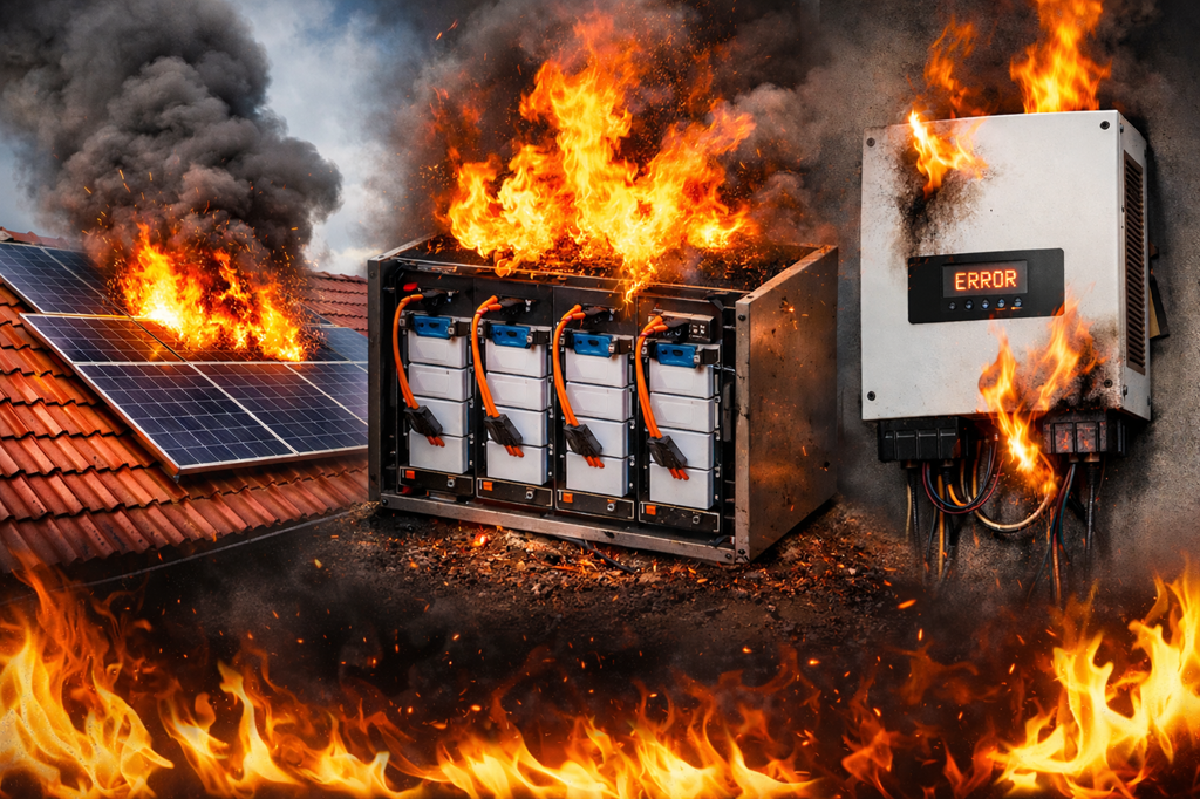
Causes Of Solar Panel Fires, Battery Explosions & Burning Inverters - Prevention & Safety Guide
There are cases of explosions and fire outbreaks due to solar power installations. Despite the exponentially number of solar installations (about 0.2 MW to 1.5 MW or 150 to 400 daily installations in Nigeria and 1.8 GW to 2.1 GW or 10,000 to 15,000 installations globally), and the extremely rare chances of solar fire outbreak happening, which is at about about 0.01% or 1 in 10,000 installations, it is still worthwhile to know the potential hazards that can led to this unfortunate fiery experience and prevent its likelihood.
Videos of solar panels on fire, burning buildings as a result of solar installation, inverter fire, or battery explosion always trend on social media whenever it happens, and it sticks as a living-day nightmare to people who have solar energy systems in their home, as well as potential owners.
This has led many to wrongly conclude that solar panels should not be mounted on rooftops, and that a separate stand, such as carports, should be constructed for them. It has also led to some landlords not allowing solar panels to be installed on their roofs.
In this article, we will cover the potential hazards that can cause fire outbreaks on solar installations, traced to solar panels, inverters, batteries, or from the installation of the solar system itself, as well as what can be done to prevent sucha solar disaster from happening.
We have also made a detailed solar safety video illustration on this topic. You can watch it below::
https://www.youtube.com/embed/IVtzAXpyk80
Hazards That Can Lead To A Fire Outbreak From Solar Panels
These are fire outbreaks from solar installations that can be traced primarily to the solar panels themselves. Factors that can cause or contribute to it are:
Hot spots: Solar panels whose glass is broken, cracked, or shattered can create what is called hot spots, which are basically heat concentration on some areas of the solar panel. Hot spots can also be created by the presence of debris, such as leaves, bird droppings, and other forms shadings which makes the shaded cells/portions of the solar panels stop converting power and instead act as resistors, causing that part to overheat. These hot spots, which also follow lines of weakness on the solar panels called snail trails, are a sign of electrical current not flowing properly through the solar panel. The hot spots on the solar panels can get so hot and start burning from underneath.
Faulty Diode: The diode, which is located inside the junction box underneath the solar panels control the flow of electrical current. If the diode goes bad, it will be unable to direct the flow of current around shorted cells/shaded areas of the solar panels. This creates the dreaded hotspots that can result in a fire.
Manufacturing Defects: This is rarely the case. An extremely rare number of panels, with exceptionally low quality, can come with some manufacturing defects.
Buying Used (Tokunbo) Solar Panels: Many used solar panels exported to mostly third-world countries like Nigeria are approaching their end of product life cycle, where they become very costly and difficult to discard and recycle. Some of these solar panels are outright bad. Snail trails and miniature cracks can also appear on aged panels over their many years of use. These lines of weakness are signs of poor flow of electrical currents, which creates hotspots that can potentially lead to a fire outbreak.
Undersized Cables: Using a smaller size of solar cable can lead to a fire outbreak because the wire cannot handle the amount of current flowing through it. It gets hot, melts the insulators, bridge, and can burn.
Poor Installation: Making a wrong connection, improper use of electrical tapes to mask wire connections, which can fall out with cycles of rainfall and dryouts, solar wire pressed tightly on sharp edges like roof and window frames, etc.
Prevention:
Do not use broken solar panels. If any is found to be broken during the course of installation, it is best to get a new one.
Watch out for the formation of hotspots on solar panels.
Scheduled maintenance to clean and remove debris from solar panels.
Ensure the solar panels are not shaded.
Use the right size of solar wire for installations. Also, confirm originality from the seller.
Buy quality brands of solar panels. If you must buy imported or locally used solar panels, have an experienced professional check them first.
Have only experienced solar technicians install your solar.
Ensure all safety guards, including solar panel mounting racks and holders, etc are used.
Hazards That Can Lead To Inverter Fire
Here are potential causes of fire outbreaks on solar power installations whose root cause can be traced to the inverter itself. They include:
Overvoltage: Especially on high-frequency/high-voltage solar hybrid inverters. When the voltage from the solar panel connection exceeds the maximum allowable by the inverter, the inverter can overheat and burn.
Undersized Wires: If the wire feeding into and out of the input and output of the inverter is undersized or of poor quality, the wires can burn out and start a fire.
Inverter Overheating: An inverter can overheat and potentially cause a fire if its safeguards fail. This can happen due to a component failure, like the fans or an internal short circuit inside them.
Poor Installation: A poorly installed inverter creates a big fire hazard. Inverters should have a minimum amount of spacing between its blow out fan and the wall or barrier, to ensure free expulsion of heat. Inverters should also not be installed in direct sunlight but in well-ventilated areas away from water intrusion. When these are not adhered to, it can heat up, short-circuit, and pose a fire threat.
Prevention:
Proper inverter voltage sizing: In stringing up your high-frequency or high-voltage solar hybrid inverters, do not max out the inverter's maximum open voltage capacity, but make adequate room for voltage spikes during cold weather.
Aim for higher quality inverters that have a degree of inbuilt fail-safe protections, like overvoltage and over-temperature protection.
Get a professional to install your solar inverter systems and ensure only recommended components are used.
Maintenance & Monitoring – Repair faults as soon as they occur and watch out for irregularities such as unusual noise, heat, etc.
Hazards That Can Lead To Inverter Batteries Exploding & Burning
Inverter batteries, especially lithium batteries, are a leading cause of fire in solar power installations. Lithium batteries have a much higher energy density, but they must be installed following the manufacturer's instructions.
The following are potential hazards that can result in fire outbreaks from the battery component of a solar installation:
Overcharging: Dead or highly sulphurated batteries with faulty or shorted cells might keep absorbing current & heating up, and can swell and explode. Solar inverter batteries can also be overcharged by faulty inverters or solar charge controllers. However, this should not be confused with battery equalization, which is a controlled overcharge for maintenance and longevity.
No Battery Management System (BMS): This is compulsory for lithium batteries to effectively communicate with the inverter.
Battery mismatch: Mixing old and new batteries or batteries of different sizes can lead to the batteries overcharging and overheating.
Physical damage: This can happen from falls, bent terminals, etc. In lithium batteries, physical damage can lead to thermal runaways, which can result to explosion and fire breakouts.
Poor battery maintenance: When the distilled water in tubular batteries dries out, they overheat, and dangerous levels of hydrogen are released, and a shorted cell can led to fire.
Battery's inherent fault: This majorly comes from internal short-circuited cells from age or a manufacturing defect.
Prevention:
Use only quality chargers (inverter, battery charger, solar charge controller), and only charge at the recommended charging currents.
When installing lithium batteries, ensure that the inverter has a battery management system (BMS) and is compatible with the lithium battery itself.
Discard faulty batteries; don't attempt to improve capacity by mixing old and new batteries in the same battery bank.
Watchout for physical damage on new batteries.
Proper maintenance and monitoring – Ensure distilled water for tubular batteries doesn't go below the minimum level. Watchout for signs of issues like excess bubbling, heat, swelling, smell, etc.
Buy good-quality battery brands.
Causes Of Fire On Solar Energy Systems Due To Poor Installation
These are faults from the installers and the installation process itself that can result in fire. Many of the potential hazards listed above also cut across the installation and can be avoided if an experienced technician does the solar installation. Most of the risks from the installation itself arise when one buys solar components themselves and looks for nearby electricians, who might not be qualified or experienced for the job.
For example, an experienced solar engineer will know how to properly mount solar panels and insulate them properly, the necessary protections to install for any solar setup, how not to surpass an inverter's recommended voltage, detect wire mismatch, understand proper setups, etc.
Natural Acts
While not explicitly categorized, fire in solar installations can be attributed to uncontrollable acts of nature like flooding, strong winds, rodents chewing away wiring insulators, etc. These can topple solar setups, rip wires, bridge wires, and cause short circuits that can potentially start a fire.